
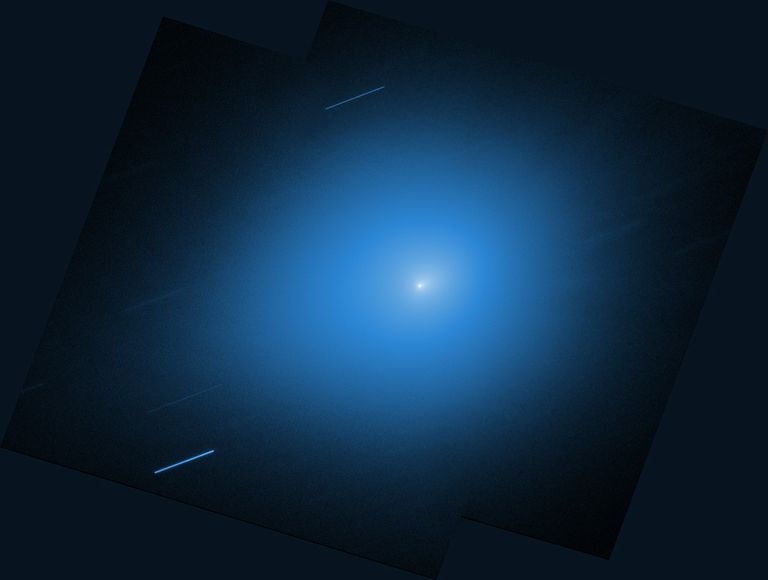
Six days ago, a team of astronomers published a finding in the journal Nature that quietly rewrote what scientists thought they understood about the chemistry of the early universe. The interstellar comet known as 3I/ATLAS — a frozen wanderer that spent millions, possibly billions, of years drifting between the stars before briefly passing through our solar system — is between 10 and 12 billion years old. That makes it nearly three times older than our entire solar system, which formed roughly 4.6 billion years ago. It is, by a wide margin, the oldest comet humans have ever directly studied, a fossil from an era of the galaxy that existed before our sun had even ignited.
The discovery caps off nearly a year of extraordinary scientific attention directed at a single small, icy object — only the third confirmed interstellar visitor ever detected passing through our solar system, and the most thoroughly studied by an enormous margin. What astronomers have learned from it in 2025 and 2026 amounts to one of the more genuinely significant planetary science stories of the decade, even though the object itself never posed any danger and is now departing the solar system for good.
A Visitor Unlike Anything Seen Before
3I/ATLAS was first spotted on July 1, 2025, by the Asteroid Terrestrial-impact Last Alert System survey, observing from Río Hurtado, Chile. Within a day, its orbit had been confirmed as extreme enough to rule out any possibility of solar system origin: an eccentricity of roughly 6.1, an inclination exceeding 175 degrees — meaning it travels almost directly opposite to the orbital plane that every planet in our solar system follows — and a velocity of approximately 58 kilometers per second, the fastest of any interstellar object yet recorded. Objects bound to our sun follow elliptical orbits with eccentricities below 1. An eccentricity of 6 is not a subtle anomaly. It is definitive proof that whatever 3I/ATLAS is, it did not form here, and it is not staying.
It joined a brief list. 1I/’Oumuamua, discovered in 2017, was the first confirmed interstellar object ever detected — a strange, elongated body that exhibited unexplained acceleration without any visible sign of gas or dust being released, fueling years of speculative debate, including a much-publicized suggestion from a Harvard astrophysicist that it might be artificial. 2I/Borisov, discovered in 2019, behaved more conventionally, showing gas emissions and dust properties broadly similar to comets native to our own solar system, albeit with an unusually high carbon monoxide content. 3I/ATLAS, the third confirmed visitor from beyond our solar system, has turned out to be the strangest and most scientifically rewarding of the three.
A Comet With Water Unlike Any Ever Measured
The first major finding to emerge from the intensive observation campaign came from a team using the Atacama Large Millimeter/submillimeter Array in Chile, who achieved something that had never been done before for an interstellar object: a precise measurement of the ratio between ordinary water and deuterated water — water in which one hydrogen atom is replaced by deuterium, a heavier isotope of hydrogen — in the comet’s coma.
The result was unlike anything found in any comet native to our own solar system. Astronomers have discovered that 3I/ATLAS’s water has an exceptionally high deuterium ratio, a chemical marker indicating that the comet’s ice originated in an extremely cold environment, probably around a star system unlike ours, billions of years before our sun formed. The research team noted this marked the first time scientists had successfully performed this specific type of water isotope analysis on any interstellar object, made possible only because astronomers detected 3I/ATLAS early enough in its approach to secure detailed follow-up observing time, including dedicated time at the MDM Observatory in Arizona, where researchers caught some of the first signs of gas emission from the comet as it warmed.
What James Webb Found When the Comet Lit Up
The most consequential observations came in December 2025, as 3I/ATLAS moved away from the sun after its closest approach in October. Having just warmed by its perihelion passage, the comet’s ancient ice had converted into a bright, active coma of gas — exactly the conditions astronomers needed to point the James Webb Space Telescope at it and capture a detailed chemical fingerprint.
What Webb detected surprised the research team. The ratios of chemical compounds present in 3I/ATLAS’s coma did not match the patterns found in any comet that formed within our own solar system. Working backward from those unusual chemical signatures — essentially reverse-engineering the formation environment from the finished chemical product — the team behind the Nature paper published on June 22 concluded that the comet most likely formed in the proto-planetary disc of a star system that existed when the Milky Way galaxy itself was significantly younger, in a galactic neighborhood with a markedly different chemical composition than the one our solar system formed within billions of years later.
A separate strand of research, examining how interstellar objects are altered during their journey through the galaxy, adds an important layer of nuance to interpreting these findings. A 2025 study modeling the effects of galactic cosmic ray exposure concluded that long-residence interstellar objects like 3I/ATLAS primarily reveal cosmic-ray-processed material on their surface, rather than perfectly pristine material representative of their original formation environment — meaning that billions of years of radiation exposure during its journey through interstellar space has chemically altered the comet’s outer layers in ways that astronomers must carefully account for when reconstructing its origins. The comet is not a perfectly preserved time capsule. It is a time capsule that has weathered a journey longer than almost anything else humans have ever directly examined.
A Close Call With Mars, and a Coming Encounter With Jupiter
Beyond its chemistry, 3I/ATLAS’s trajectory through the solar system gave astronomers a rare opportunity to study how an interstellar object interacts gravitationally with planets along its path. The comet passed within roughly 0.194 astronomical units of Mars on October 3, 2025 — a close approach by astronomical standards, close enough that Mars-orbiting spacecraft, including NASA’s Europa Clipper mission, which was transiting through the inner solar system, could capture rare ultraviolet observations of the comet while ground-based telescopes on Earth were blinded by the sun’s glare.
A second, more distant gravitational encounter occurred on March 16, 2026, when 3I/ATLAS passed within approximately 0.357 astronomical units of Jupiter. Dynamical simulations published by researchers at India’s Physical Research Laboratory modeled how both encounters perturbed the comet’s trajectory, providing astronomers with an unusually detailed record of exactly how the gravity of two planets nudged an object that had been traveling, essentially undisturbed, for billions of years before it ever entered a planetary system again.
These encounters were never going to bring 3I/ATLAS dangerously close to Earth — at no point during its solar system passage did the comet pose any meaningful approach risk to our planet — but they offered scientists an extraordinarily rare natural experiment: watching, in real time, as the orbit of a multi-billion-year-old interstellar traveler was measurably reshaped by the gravity of planets it was only ever going to visit once.
Why a 12-Billion-Year-Old Snowball Matters
It would be easy to treat the story of 3I/ATLAS as a pleasant astronomical curiosity — an old rock that happened to swing through our cosmic neighborhood and is now leaving again, never to return. The scientific significance runs considerably deeper than that.
Every comet carries, frozen within its ice, a chemical record of the environment in which it originally formed. Comets native to our solar system have given astronomers detailed insight into the conditions present during our own solar system’s formation, 4.6 billion years ago. An interstellar comet — particularly one as ancient as 3I/ATLAS — offers something fundamentally different: a direct chemical sample from a star system and a galactic environment that existed and then vanished long before our own sun condensed out of its parent nebula. As Roberto Maiolino of the University of Cambridge described a separate, related Webb finding about an extremely distant black hole earlier this year, discoveries of this kind represent “a paradigm shift, a total revisiting of the classical scenarios” — and the same description applies, with equal force, to what 3I/ATLAS has revealed about the chemical diversity of planetary system formation across cosmic time.
Only three interstellar objects have ever been confirmed passing through our solar system, and each has behaved meaningfully differently: ‘Oumuamua’s unexplained acceleration, Borisov’s broadly familiar but carbon-monoxide-rich composition, and now 3I/ATLAS’s unprecedented age and alien water chemistry. With new, more sensitive sky-survey instruments — including the Vera C. Rubin Observatory, which captured detailed imagery of 3I/ATLAS during its own science validation testing — coming online in the years ahead, astronomers expect the rate of interstellar object discovery to accelerate substantially. 3I/ATLAS may be remembered, in retrospect, not as a singular anomaly but as the first of many ancient interstellar visitors that a new generation of telescopes is now equipped to find, study, and use to reconstruct the chemical history of our galaxy, one frozen traveler at a time.
Sources: Nature, “Chemical composition and age constraints on interstellar comet 3I/ATLAS” (June 22, 2026); EarthSky, “Comet 3I/ATLAS Over 10 Billion Years Old, Webb Finds” (June 22, 2026); University of Michigan / Nature Astronomy, “Interstellar Comet 3I/ATLAS Contains Strange Water Never Seen in Our Solar System” (May 8, 2026); arXiv, “Interstellar Comet 3I/ATLAS: Evidence for Galactic Cosmic Ray Processing” (Maggiolo et al., 2025); arXiv, “Dynamical Simulation of the Interstellar Comet 3I/ATLAS” (Ahuja & Ganesh, Physical Research Laboratory, 2025); Wikipedia, “3I/ATLAS” (updated June 2026); arXiv, “Snapshot of a New Interstellar Comet: 3I/ATLAS Has a Red and Featureless Spectrum” (2025); NASA Science, James Webb Space Telescope Latest News.