
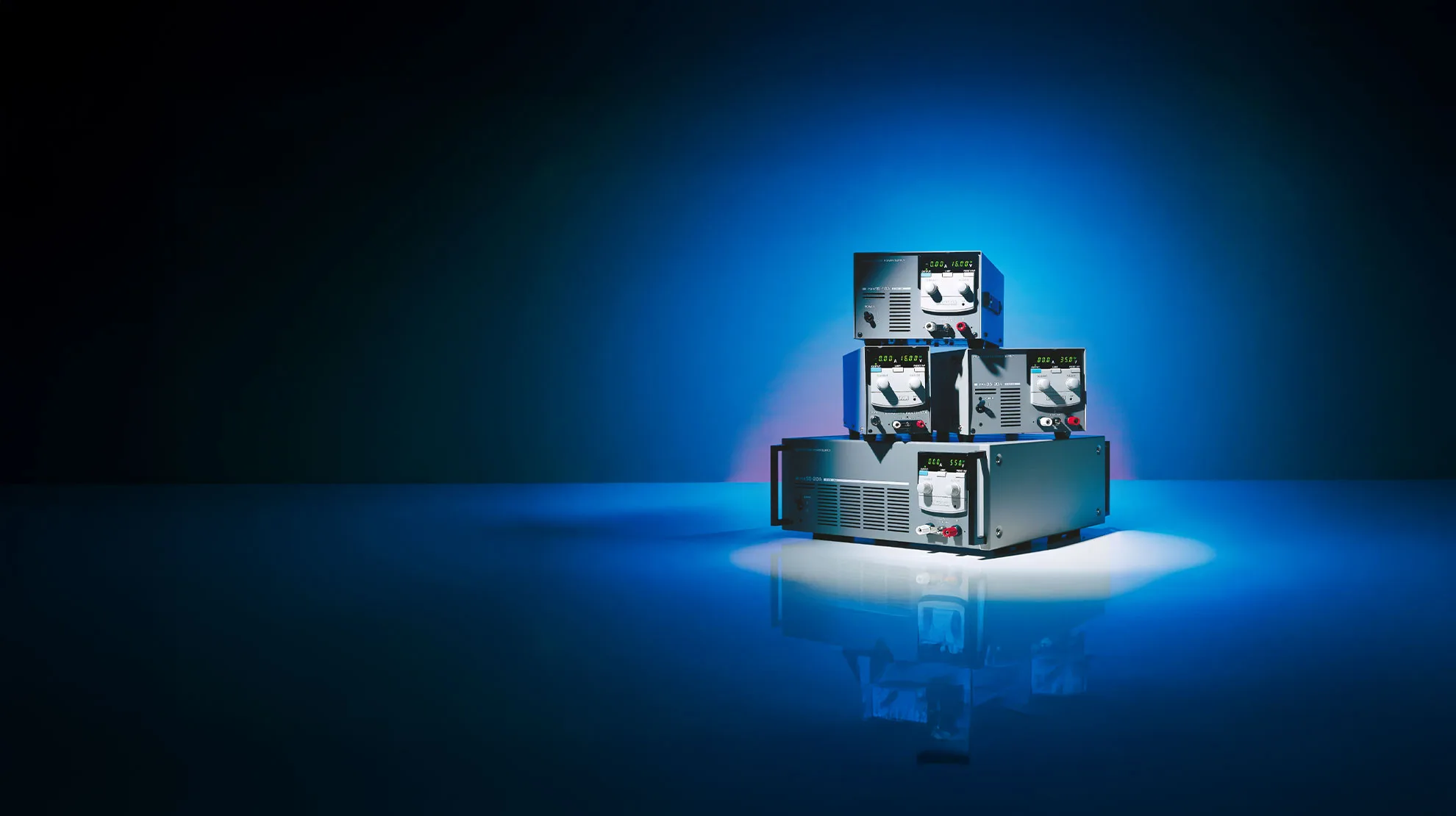
Every electric vehicle battery pack rolling off a production line in 2026, at some point, connects to a DC power supply that simulates thousands of charge and discharge cycles before a single customer ever plugs it in. Every server rack powering the AI boom’s data centers depends on DC power conversion equipment validated against test benches that look nothing like the gleaming hyperscale facilities they ultimately serve. Satellites, electric motors, and pieces of power electronics shipped this year have passed through a piece of equipment that almost nobody outside an engineering lab has ever heard of: the programmable DC power supply.
This is the unglamorous infrastructure layer beneath the headlines about electrification, AI infrastructure, and the energy transition. In 2026, demand for it is colliding with technical requirements that are pushing the entire category into unfamiliar territory.
A Market Growing Quietly, But Growing Fast
Analysts expect the global DC power supply market to grow at a compound annual rate between 4 and 5%, with most forecasts predicting it will reach $1 billion or more within the next decade. Those numbers, on their own, look modest next to the trillion-dollar narratives dominating technology coverage this year. But the growth drivers underneath them reveal an industry that has become structurally indispensable to nearly every electrification trend currently reshaping the global economy.
In the United States specifically, more than 40% of DC power supply demand originates from electronics manufacturing, semiconductor testing, and R&D laboratories, with over 25% linked directly to automotive, EV, and battery testing applications, and roughly 15% tied to aerospace and defense programmes. Battery pack testing requirements are growing at an estimated 34% compound annual rate — a pace that outstrips nearly every other segment of the broader test and measurement industry. Output power ranges between 500W and 5kW, account for roughly 52% of demand in test and measurement systems, while high-power units above 10kW now serve approximately 31% of battery testing and renewable energy simulation platforms.
The 800-Volt Problem
The single biggest technical disruption reshaping DC power supply specifications right now is the rapid industry shift toward 800-volt electric vehicle architectures.
For these earlier generations of EVs, DC test equipment matured over a decade. The newer generation of 800V platforms — adopted to enable faster charging and reduce cable and connector weight — demands an entirely different class of test equipment: systems capable of 1,200V operation with ultra-low ripple characteristics, bidirectional power flow to simulate both charging and discharging cycles, and the ability to emulate battery management system communication protocols in real time. More than 40% of newly launched programmable DC power supplies now support output voltages up to 1,000V and currents above 300A, a direct response to this architectural shift across the EV industry.
This is not a trivial engineering challenge. A power supply validating an 800V battery pack must maintain voltage accuracy within roughly ±0.02% and ripple noise below 5 millivolts peak-to-peak, while responding to transient load changes in under 100 microseconds — fast enough to simulate the instantaneous power demands of regenerative braking or aggressive acceleration. Manufacturers serving this segment have responded with modular DC test architectures that scale from benchtop units in the 1 to 5kW range up to rack-mounted systems exceeding 200kW for full production-line testing, using primary/secondary parallel operation with automatic current sharing across multiple units.
Bidirectional DC power supplies — capable of both sourcing power into a device under test and absorbing power regeneratively, the way a battery both charges and discharges — now represent nearly a third of high-power installations in EV battery testing, improving energy recycling efficiency by an estimated 29% compared to older resistive load-bank testing methods that simply burned excess energy as heat.
Why Semiconductors Changed the Specification Sheet
The second major force reshaping DC power supply design is the global shift toward wide-bandgap semiconductors — silicon carbide (SiC) and gallium nitride (GaN) — which are displacing traditional silicon in everything from EV inverters to data center power supplies.
SiC and GaN devices switch faster and run hotter than silicon, and validating them requires test equipment with correspondingly higher capacity, faster transient response, and tighter noise specifications. Roughly 42% of new DC power supply platforms launched in the past year now incorporate silicon carbide and gallium nitride switching devices internally, pushing conversion efficiency above 94% and reducing thermal losses by close to 26% relative to previous-generation designs. That efficiency gain compounds at scale: a power supply running continuously in a 24/7 test laboratory or production environment that is several percentage points more efficient translates into meaningfully lower energy costs and heat-management overhead across a facility running dozens or hundreds of units in parallel.
Digital control interfaces have become close to universal in new installations — roughly 63% of new systems now integrate digital control loops that improve voltage setting accuracy to within ±0.02% — while programmable DC power supplies account for nearly half of all new shipments across the industry. These interfaces mirror the larger trend from manually adjusted analog equipment to systems that offer scripting, automation, and direct integration into production-line test sequences using LAN, USB, or GPIB connections.
The Data Centre Connection
For decades, electronics manufacturing and automotive test labs primarily anchored the market, but the AI infrastructure boom has now introduced an unexpected new source of demand.
Data centers and ICT infrastructure now account for more than 35% of industrial DC power supply deployment, as hyperscale facilities increasingly adopt DC bus architectures and require redundant DC supply modules to validate power delivery systems before they ever reach production racks. The shift toward 800V-class high-voltage DC architectures inside data centers — designed to reduce the conversion losses inherent in traditional AC distribution — has created an entirely new validation requirement: power supplies capable of testing the kind of high-voltage DC infrastructure that data center operators are only beginning to deploy at scale.
This convergence is not coincidental. The same wide-bandgap semiconductor technologies powering the EV transition are also powering the next generation of data center power conversion. The same bidirectional, high-precision DC test equipment validating EV battery packs is increasingly the same category of equipment validating server power supplies, UPS systems, and battery energy storage installations supporting AI data center backup power. A single technology category — precision DC power supplies and electronic loads — now sits underneath two of the most capital-intensive infrastructure buildouts in the global economy simultaneously.
What Buyers Are Actually Looking For
For engineering teams selecting DC power supply equipment in 2026, the purchasing criteria have shifted noticeably over the past decade. Raw output power remains a baseline requirement, but it is no longer the primary differentiator. Increasingly, buyers are prioritizing wide output ranges that allow a unit to cover multiple voltage and current combinations without requiring separate equipment for each test scenario; bidirectional capability that supports both sourcing and regenerative load testing within one system; digital interfaces and remote monitoring that allow integration into automated, unattended test sequences; and rack-mountable form factors that maximize power density within the limited physical footprint of a modern test laboratory or production floor.
Established instrumentation manufacturers with decades of precision power electronics experience — including long-standing Japanese manufacturers such as Kikusui, alongside Keysight, TDK Lambda, and Chroma ATE — have responded to this shift with increasingly modular, high-density product lines spanning compact benchtop units through multi-kilowatt rack systems, including bidirectional architectures specifically engineered for EV battery and inverter validation. Kikusui’s current DC power supply lineup, for instance, spans roughly 300 models, from compact 35-watt linear units suited to sensor and component-level testing through to bidirectional systems delivering up to 20 kilowatts in a single 3U rack enclosure at voltages up to 1,500V — illustrating just how wide the specification range has had to stretch to keep pace with the demands of modern battery, inverter, and power semiconductor testing. The breadth of that range is itself a signal of how diversified the underlying demand has become: the same manufacturer’s catalogue now has to serve a sensor calibration lab, an EV battery production line, and a data center power validation facility with different technical requirements, often within the same product family.
The Infrastructure Nobody Notices Until It’s Missing
DC power supplies will never generate the headlines that an EV launch, a new AI chip, or a data center groundbreaking commands. But every one of those headline stories depends, several layers down, on whether engineering teams can reliably and precisely validate the power electronics inside the product before it ships.
As 800V EV architectures become the industry standard rather than the premium exception, as wide-bandgap semiconductors continue displacing silicon across power conversion applications, and as data center operators race to build out the high-voltage DC infrastructure that AI compute demands, the specification bar for DC test equipment will keep rising. The companies that get this layer of infrastructure right — precise, fast, bidirectional, digitally integrated — are quietly enabling every other electrification story currently being told. The companies that get it wrong will discover the cost of that mistake much later, on a production line, at a scale that is far more expensive to fix than a test bench ever was.
Sources: Market Reports World, DC Power Supply Market Size Global Report (2026); Industry Research, DC Power Supplies Market Size & Growth Report (January 2026); Future Market Insights, DC Power Supplies Market Size & Forecast 2025-2035; Intel Market Research, DC Test Power Supplies Market Outlook 2026-2034 (March 2026); Business Research Insights, DC Electronic Load Market Size & Share Report (April 2026); Research and Markets, DC Power Supplies Market Size & Forecast to 2032; Intel Market Research, Data Center Power System Market Outlook 2026-2034; Kikusui America, DC Power Supplies product range.